

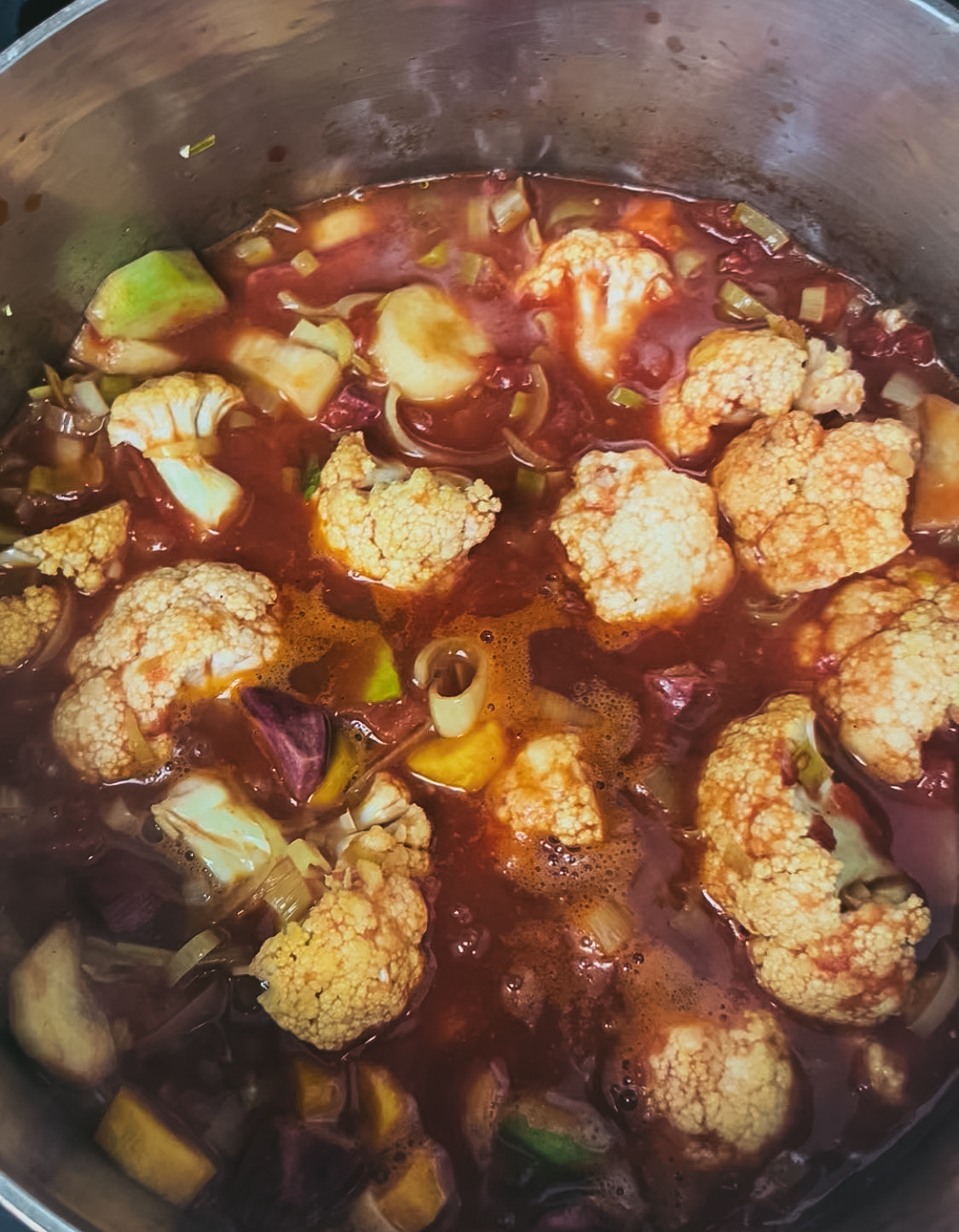
05 Oct An inauthentic, authentic Rainbow curry
What is an authentic curry anyway?
I wanted to call this an inauthentic curry, so that no-one thinks it’s from a particular country or that I’m trying to do something and getting it wrong. In our family, this is a Rainbow curry and it’s a very authentic one, because, as you can clearly see, it’s very colourful. Not knowing how to name it made me start thinking about what curry is anyway. The word has Tamil roots, where kaṟi means spiced meat or vegetables. It was adopted by the Portugese and Dutch traders first. The English spelling (almost) first appeared in Hannah Glasse’s Cookbook in the 18th Century. In Thailand, they only use the word “curry” so that Westerners understand what it is they’re eating. In the native language the curry dishes would be called kaeng. All which leads me to believe that a curry doesn’t need to be “authentic”, because hardly any curry is.
A way to get all those colours and plants in
The theory is that we should be eating plants all the colours of the rainbow, because all those colours contain different benefits. Red is lycopene for heart health,
Orange and yellow contain carotenoids, which your body turns into vitamin A for vision, skin, and immune health. Green means chlorophyll, folate, and vitamin K, which help build strong cells, support blood clotting and reduce inflammation. Blue means anthocyanins that protect brain cells, improve memory, and lower heart disease risk. And finally, white and brown contain allicin and flavonoids that fight bacteria and support your immune system. Of course, diversity has also been the buzzword for gut health recently, as it’s generally linked to resilience.
The recipe for Rainbow curry
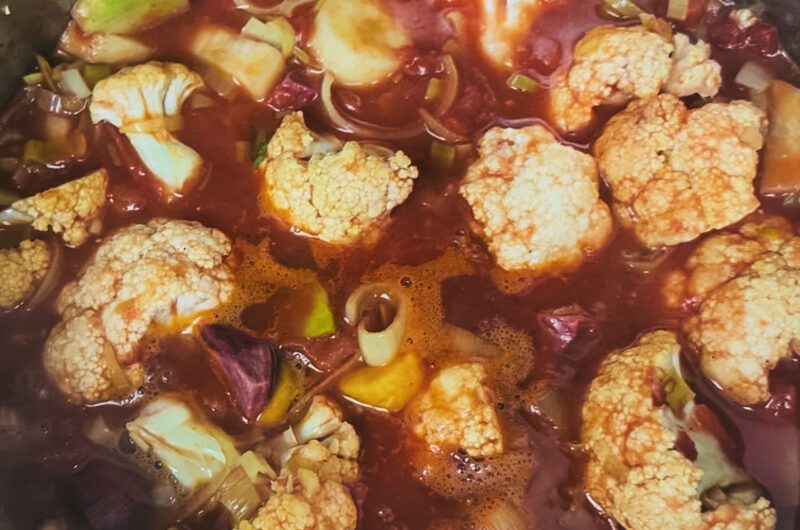
I like to make this curry on days when we are going to be out and about, eating whatever we can get our hands on. Then we come home to a curry that’s already made and get our daily dose of colourful plants. This always feels like a win. Of course, being me I forgot to take a picture of the said curry when I made it. I only had a couple of videos, but I hope that this is sufficient to make you try it.
An inauthentic, authentic Rainbow curry
Course: Uncategorized8
servings20
minutes40
minutesA great way of getting those diverse plants into one meal. You can swap and change the veggies as you see fit.
Ingredients
1 tablespoon coconut oil
1 small onion, finely chopped
1 leek, finely sliced
2 garlic cloves, crushed
2cm ginger, peeled and finely chopped
Handful of coriander, chopped with stalks
1 teaspoon garam masala (or half cumin, half cinnamon)
1/2 teaspoon turmeric
1 tin chopped tomatoes
3 carrots (any colours), peeled and sliced
1/2 Half a cauliflower, separated into florets
Large sweet potato or 2 smaller ones, peeled and diced
Tin of coconut milk
Juice of half a lime
- To serve:
Rice or wholewheat chapatis
Bio live yoghurt or crème fraiche
Fresh coriander
Toasted almond flakes
Mango chutney
Directions
- Fry the onion, leek and ginger in a deep pan until soft and slightly caramelised.
- Add the garlic and after a few moments, the spices. Stir and fry for a moment longer, then add the tin of tomatoes. Pour water into the empty tin and add that tomatoey water to the mix too, then the coriander. Season. At this point, you could transfer this to a blender and blitz to a smooth paste, depending on what you consistency you prefer.
- Bring to a simmer, then turn the heat down as you prep the veggies. Add them to the simmering sauce and when they are all in, make sure they are covered in the sauce, if not add a little more water. Simmer for 15min or so until veg are soft but not falling apart yet. I often make this earlier and simmer for half the time, then turn the heat off and leave it to infuse with the flavours, then finish off later.
- Add coconut milk near the end of cooking time along with the lime juice. Season again, to taste, before serving.